



















In June, the Argos team was present for the 55th LocWorld conference in Dublin — the European city famously responsible for kickstarting many localization careers.
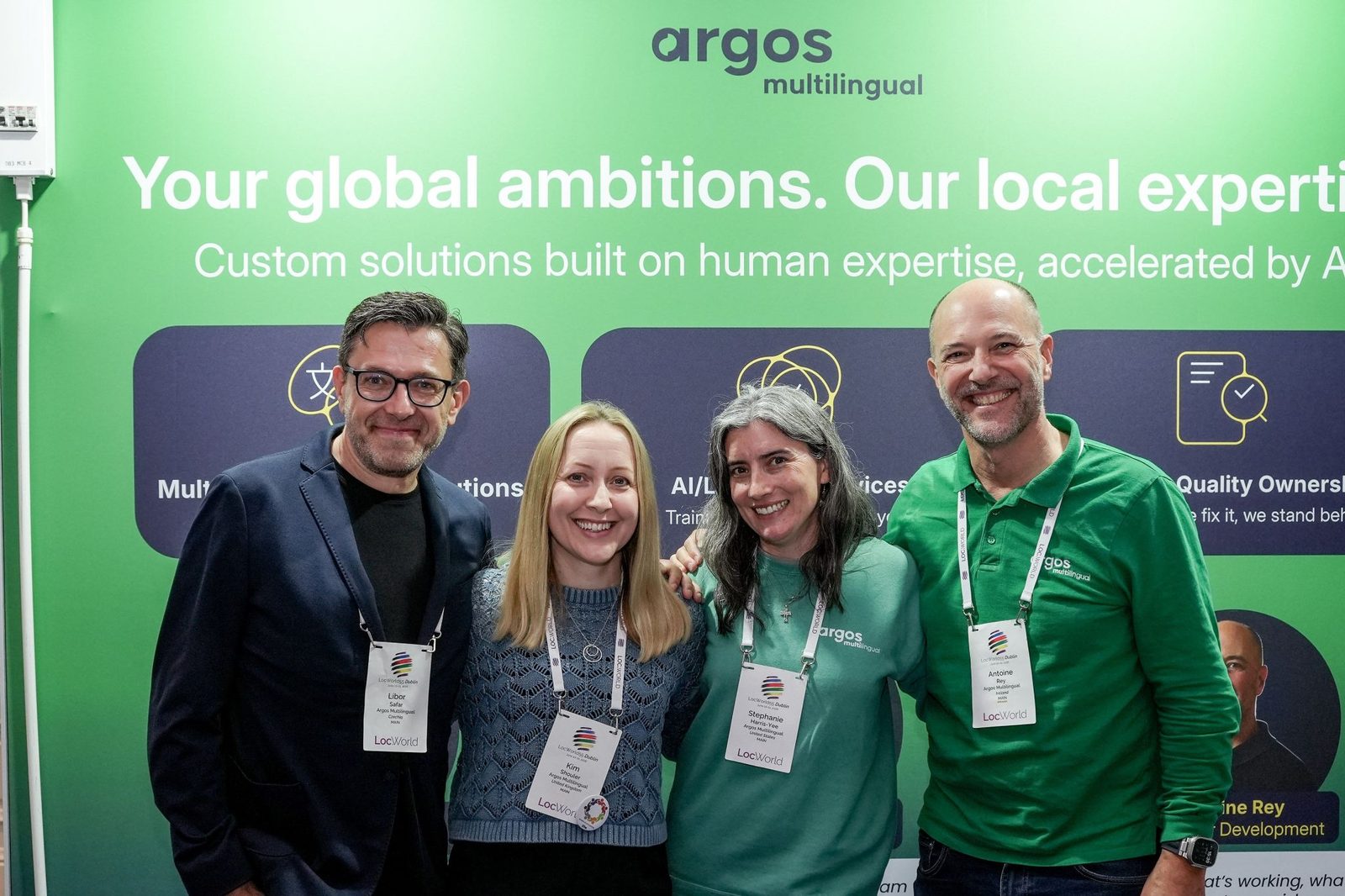
As has become our custom, we packed chocolate, we booked the best baristas to keep everyone at the top of their game, and we took part in the conference program.
The LinkedIn recaps that followed LocWorld were numerous (have there ever been so many LW recaps?), so we aim to synthesize them and bring you the key takeaways from the conference in a time-honored, SEO-friendly numbered list format.
#1: Everyone is building. Are you?
Let’s start at the top. With barriers to experimentation largely removed, Generative AI has unlocked the localization teams’ ability to build.
Traditionally, localization teams have relied on a roster of providers for technical or engineering support to connect systems or build out language-related infrastructure (often revolving around a TMS). While this is still the case, especially for teams with limited bandwidth, there is now less and less reliance on providers’ help: Today, LLMs allow localization professionals with initiative (or a quarterly OKR) to prototype workflows, internal tools, and automations that previously required dedicated engineering support.
Scrappiness and agility are the name of the game. LLMs enable localization and globalization teams to do far more than they ever could before due to time or cost constraints — and the teams are clearly encouraged (if not downright mandated) to have a go at it. For example, at GitLab, the teams have a “bias for action.” They are encouraged to build. At KnowBe4, the localization team has built an AI-powered system to process user feedback at scale, surfacing product and content improvements from hundreds of thousands of multilingual user comments.
As we see the AI (r)evolution continue to shake out in the business world, client-side localization teams that adopt a builder mentality are the ones making the biggest strides.
#2: Localization expertise, delivered to the machines
The session “Shifting Left: How AI-Powered Internationalization Transforms Global Product Development” brought representatives from GitLab, Spotify, Expedia Group, and Salesforce on stage to provide a level-headed outlook on how AI is rewriting the rules of software development.
It used to be that localization teams were redirecting software developers to documentation on internationalization best practices and crossing their fingers, hoping they’d read it. Today, localization teams can, with the help of AI, create tools directly embedded in developers’ workspaces (think more than simple magic buttons). What’s perhaps even more striking is that as agentic AI becomes ubiquitous, reams of design documentation are now being transformed into files that are readable by AI agents.
We’re quickly heading down the road of localization not being the sole domain of humans. Machines are increasingly accessing and reading the decades of codified expertise, resulting in autonomous systems that actually perform well at their job.
#3: A token overreliance
While not directly a topic of discussion at LocWorld, let’s mention something that surfaced once or twice in the debate and figures to be a talking point in the months to come. The downside to teams using AI wholesale is an increasing dependence on LLM inference for problems that could often be solved deterministically. This is not something uniquely reserved to the language industry. Token (over)use is a looming concern across global industries as companies are reportedly burning through their AI budgets at faster-than-light speed.
Beyond acknowledging that this is an issue, there is admittedly no clear-cut answer to this just yet, especially as the language industry is still trying to fit LLM-based AI into its workflows. But one comment from the audience stuck with us: companies need to be intentional with their resources. Sometimes, a good old deterministic script can do the same heavy lifting as an LLM-powered, token-hungry solution.
#4: Jumping at shadows
Shadow localization isn’t novel. It’s been around (i.e., in the shadows) forever, and it has been manifesting in the most innocuous — and frustrating — ways. We’ve all had that one colleague whose cousin speaks French, so they emailed them a product brochure for a quick translation. Now with AI, the phenomenon is propagating fast. Anyone in the organization can (and is) translating text or creating multilingual copy outside of sanctioned workflows, and localization teams often only hear about it accidentally.
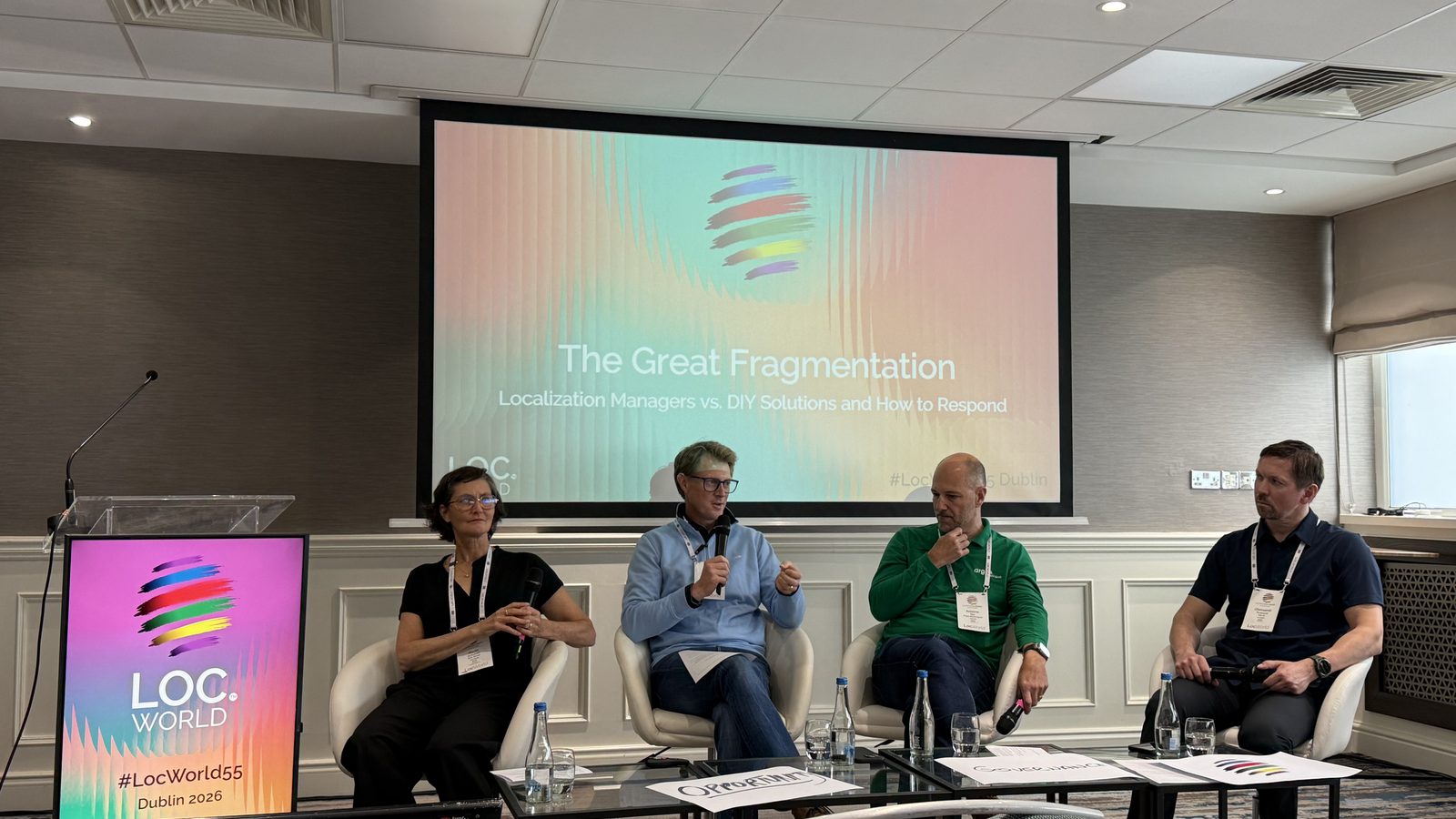
Argos’ own Antoine Rey was part of a panel titled “The Great Fragmentation: Localization Managers vs. DIY Solutions and How to Respond”, discussing how localization teams should respond to the reality of shadow localization. Yes, shadow localization may be inevitable, but the panelists reframed it as an opportunity and a signal that the business wants translation. The role of localization teams in this context should be to establish guardrails around AI use. Even better — and to our previous point about meeting users where they are — localization teams should try to embed approved translation capabilities directly into the tools people use, making the governed path the easiest one to follow.
#5: Governance, good
Which brings us to another keyword on everyone’s lips: governance.
In one of the more humor-laden sessions on the program, “The Bassline of Global Content: When Content Scales, Control Matters”, the panelists engaged in a bit of playful roleplay in a scenario where teams are instructed to use AI to turbocharge the company scaling up. What they ended up showing the audience were all the pressure points content is exposed to as it moves from creation to publication.
The paradox they exposed (one you’ve suspected all along) is that AI initiatives often fail because of the organization’s inability to align people, processes, and ownership. It just so happens that a lot of different moving parts (i.e., departments or stakeholders and their often competing objectives) need to be aligned just well enough to make the most of AI’s potential.
Governance echoed across the varied talks and hallway conversations, both as something localization teams should focus on as the stewards of responsible language use, as well as something which does not yet have a clearly defined playbook. The language industry seems to be only grasping at its role in building guardrails for the company’s use of AI. As language and cultural experts, we understand the merits of precision and nuance, but, for now, it remains unclear what effective governance looks like in practice.
#6: Quality: Yes, but
Every conference gives the topic of quality ample space, and LocWorld Dublin was no different. Quality has become the bellwether topic of the language industry. The day it no longer features on the program, you will know the times have truly changed.
That said, there was a meaningful change to how quality was talked about. The guiding principle now seems to be “How do we allocate quality effort where it matters most?”
Here are two examples:
- Spotify presented quality as an exercise in resource allocation rather than linguistic perfection. AI performs the first-pass review at scale, detecting anomalies and identifying potential issues, while humans focus on high-risk, ambiguous cases that require contextual judgment. Not every market, language, or content type receives the same level of scrutiny, and that’s very much by design. Quality becomes proportional to business impact rather than uniformly applied.
- Fix the source once instead of every language separately: this was the idea practically demonstrated by KnowBe4. Their team had been noticing language-specific complaints. But instead of verifying whether they needed a retroactive language-level fix, they thought differently: Is the source content lacking context in order to land as intended? Is the storytelling weak? Are instructions unclear? Is the UX confusing? Their realization was that many localization complaints were actually source content problems. Attend to the source content and many downstream quality issues can be avoided altogether.
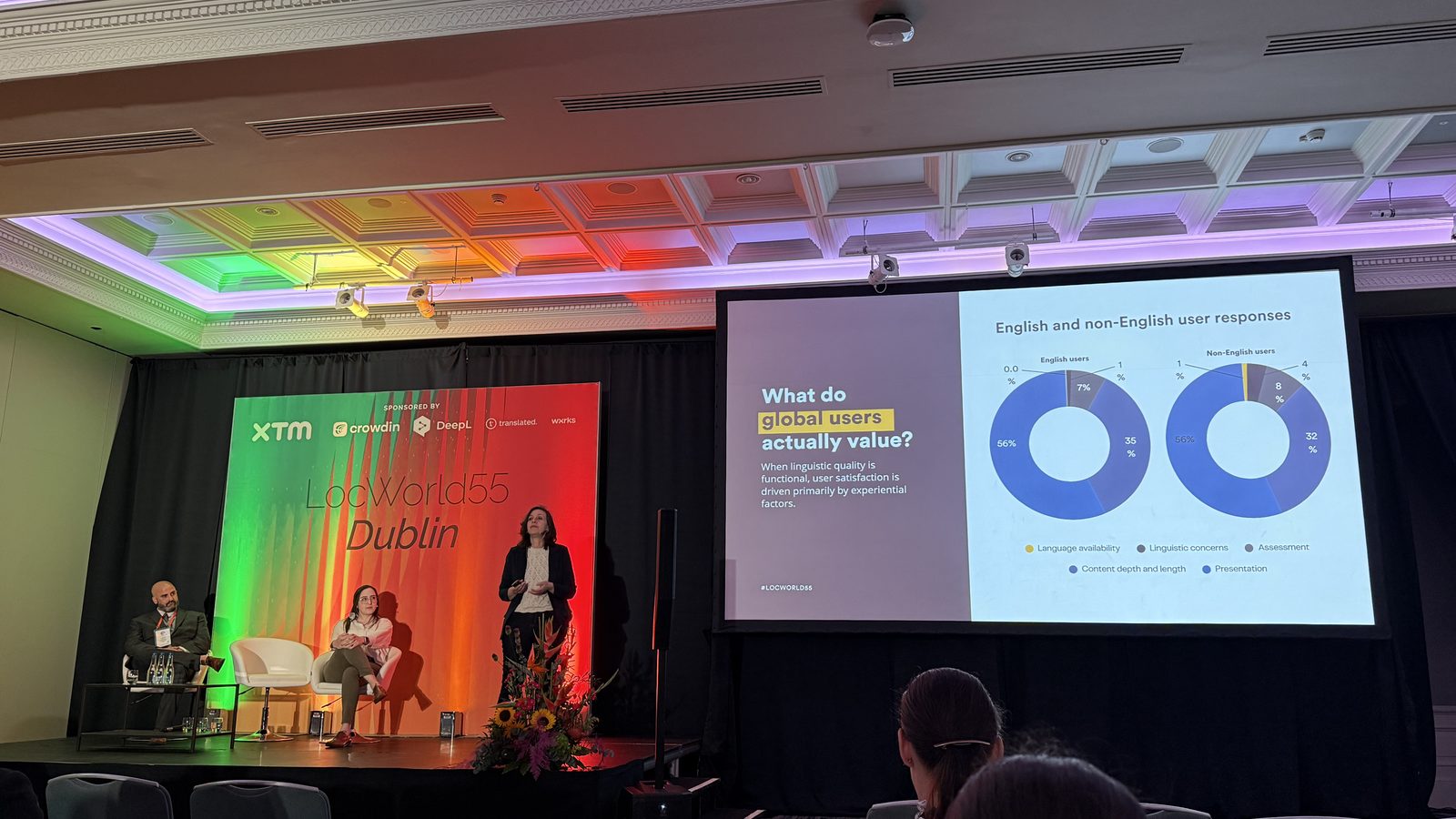
The common thread across the quality-oriented talks wasn’t simply automation — it was intentionality. Companies are becoming more selective about where they invest human attention and where they let AI carry the load.
#7: Underneath it all, Meaning
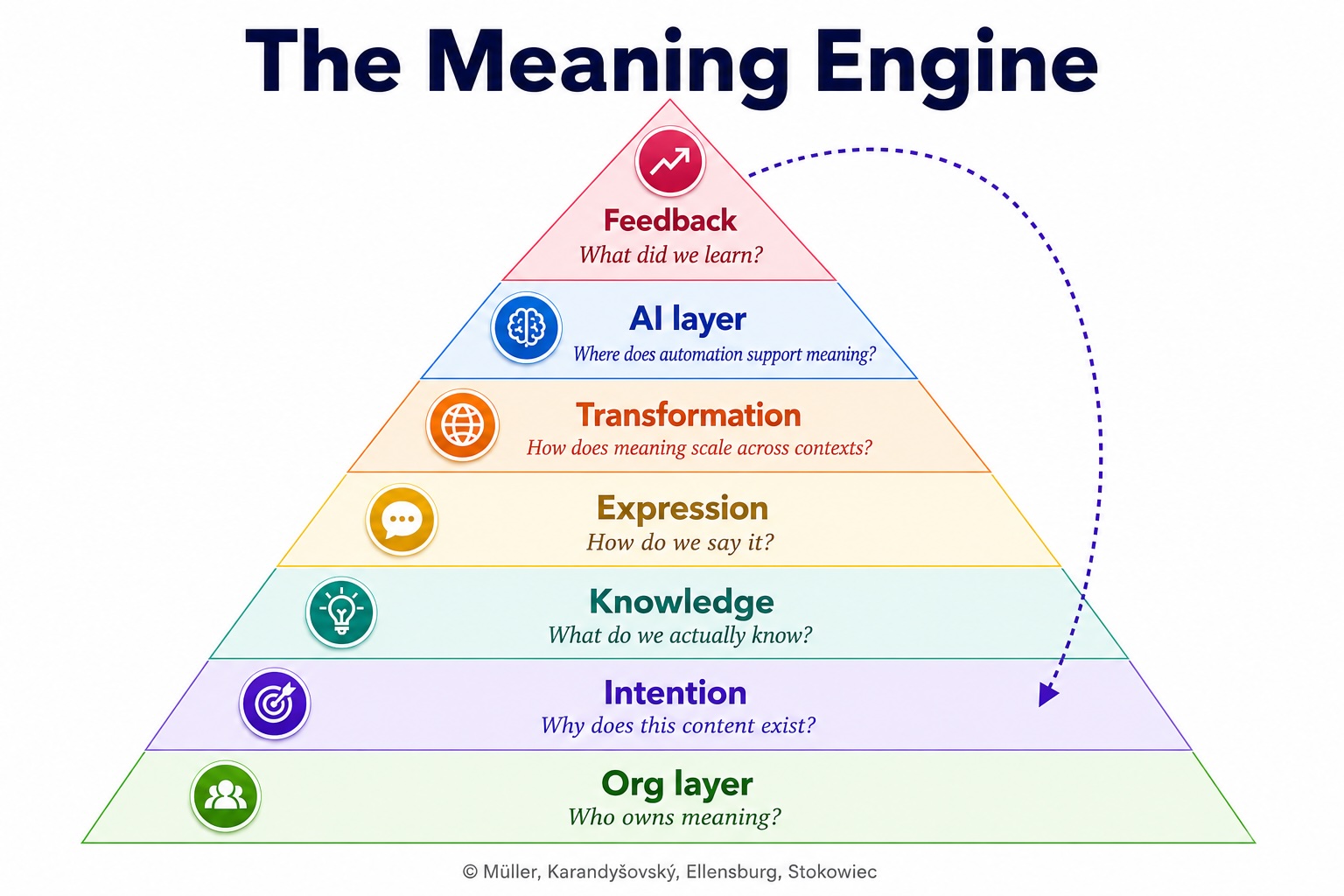
A session moderated by Argos’ Gabriel Karandyšovský, “The Meaning Engine: How AI and Multidisciplinary Teams Can Co-Create Content for Global Audiences”, very unambitiously attempted to tackle something that should underpin any decision companies creating content make: meaning.
The premise is, on the surface, simple, and all of this holds true at the same time: content is created with intention and a desired outcome, content travels and is transformed (often into different languages), content is received, and content can spur action. Throughout this journey, the teams contributing to creating and transforming the content would do well to be aligned on its meaning.
And should they not be?
Meaning is brittle and, as this AI-first age shows, risks breaking as it travels from creation to publication. What the company may have intended at the beginning is misunderstood by the user. Shopping carts get abandoned, website visitors bounce or, even worse, a brand’s image in a market is irredeemably tarnished.
The panelists proposed a framework called the Meaning Engine. Organizations can use this to guide them in defining what’s meaningful and how meaning is captured and encoded in systems that allow it to travel without breaking.
#8: Buyers at the wheel
One undercurrent we couldn’t help noticing throughout the conference, symptomatic of a larger trend playing out in the industry, was that the buyer-side localization teams are reclaiming ownership of language-related operations. What we mean by this is that we might be seeing a recalibration of the client-vendor relationship, the balance ostensibly tilting in the buyer’s favor.
Let’s unpack this. Over the past roughly four years, dating back to the arrival of GenAI, localization teams have been maturing in their attitude toward and usage of AI. This is a very natural development. During this time, often spurred on by their upper management, they have been finding the wherewithal and initiative to experiment, pilot, and build specific, niche, and small-scale solutions to their problems. The proof is in the pudding — or the conference program, to be precise. The use cases are showing tangible results, and localization remains a critical piece in any company’s global growth ambitions.
In parallel to localization and globalization teams taking back the reins, we’ve been seeing debates such as “TMS is dead” or “vendor lock-in” pop up. Yes, AI is allowing the industry to revisit traditional processes and is giving buyers new tools to work with. At the same time, more “classic” considerations such as limited budgets, time, and bandwidth, as well as the inaccessibility of AI-fluent talent, remain harsh realities.
This is the environment buyers and their providers will have to navigate for the foreseeable future — the former figuring out how far they can go on their own and the latter trying to determine how they can continue co-building the edifice.
Looking back at LocWorld55 in Dublin, it is clear that AI is not replacing language professionals. If anything, it is redirecting their attention (and expertise) toward building systems, governing AI, encoding expertise, preserving meaning, and helping the rest of the organization build better global products.
 Gabriel Karandyšovský
8 min. read
Gabriel Karandyšovský
8 min. read
LocWorld54 showed the localization industry has established a new AI-augmented baseline, with incremental progress and human storytelling remaining key.

 Argos Multilingual
2 min. read
Argos Multilingual
2 min. read
Argos Multilingual has been included in The Forrester Wave: Localization Services, Q3 2026, an independent evaluation of the localization market.